Transforming Information Into Actionable Intelligence

If you’ve spent any time around AI over the past few years, you’ve probably noticed that most of the conversation has centered on generative AI. Every conference, podcast, webinar, and LinkedIn post seems to focus on how AI can write emails, generate reports, create presentations, summarize meetings, or build software.
Those capabilities are impressive, and they’re creating real value. I’ve personally seen organizations save countless hours by using AI to automate repetitive tasks and accelerate workflows. Yet the more I work with business leaders, the more convinced I’ve become that we’re focusing on only a small part of the story.
The biggest opportunity in AI isn’t content generation. It’s organizational intelligence.
When I talk with executives, I rarely hear them complain about a lack of information. It’s the opposite. Most companies are overwhelmed by information. They have customer data, financial reports, operational metrics, strategic plans, meeting transcripts, technical documentation, code repositories, compliance records, contracts, proposals, and years of institutional knowledge scattered across dozens of systems.
The challenge isn’t collecting this information. It’s using Ai to transform it into actionable knowledge.
Organizational Silos
A surprising amount of corporate knowledge remains trapped inside organizational silos. Finance has one view of the business. Sales has another. Operations maintains its own reports. Engineering manages separate systems and documentation. Valuable insights exist throughout the enterprise, yet connecting them requires significant time and effort.
I’ve seen this firsthand in technology companies. A team can spend days searching for information that already exists somewhere inside the organization. Important documents are buried in folders. Critical decisions are hidden inside meeting notes. Historical context disappears when employees leave. The information is there, but finding it and understanding how it connects to everything else becomes increasingly difficult as organizations grow. That’s why we created Gobi AI.
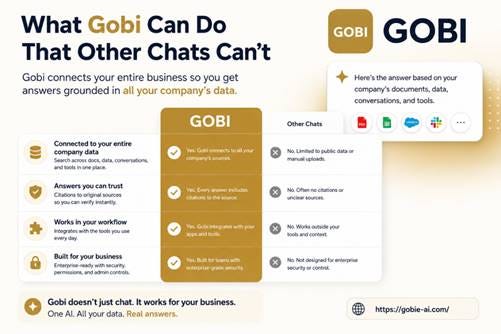
Gobie was developed to address that challenge. Instead of functioning primarily as a content generation tool, it acts as an intelligence layer across the organization. The platform can analyze large collections of documents, software codebases, reports, and workflows while helping users identify relationships, patterns, risks, and opportunities that might otherwise remain hidden. That may sound abstract until you look at real-world applications.
Imagine a private equity firm evaluating a potential acquisition.
The due diligence process can involve thousands of pages of contracts, financial statements, legal documents, employee agreements, cybersecurity assessments, customer records, and operational reports. Traditionally, teams of specialists spend weeks reviewing this information, comparing findings, and trying to identify risks.
Gobi can accelerate that process significantly. Rather than reviewing documents one at a time, it can analyze large collections of information simultaneously, identify inconsistencies, surface potential concerns, and help experts focus their attention where it matters most. The goal isn’t to replace human judgment. It’s to help people reach informed conclusions faster.
The same principle applies to software development.
Many organizations are running software systems that have evolved over years or even decades. Developers leave. Documentation becomes outdated. New team members spend months trying to understand how everything fits together. Technical debt accumulates and institutional knowledge erodes.
Gobi can analyze an entire codebase as a connected system. Developers can explore dependencies, understand architecture, identify vulnerabilities, and uncover relationships that would otherwise require countless hours of manual investigation. Instead of hunting for information, teams can focus on solving problems.
Sales organizations face similar challenges.
Responding to a complex Request for Proposal frequently requires information from multiple departments. Security certifications may be stored in one location. Product documentation may reside somewhere else. Legal language may be buried in previous proposals. Gathering the necessary information becomes a project of its own.
Gobi can help locate and connect those pieces of information far more efficiently. Teams still make the final decisions and review the final output, but the time spent searching for information can be dramatically reduced.
What fascinates me about this trend is that it represents a shift in how we think about AI. The first wave of enterprise AI focused primarily on helping individuals work faster. The next is focused on helping organizations think better.
That distinction matters because execution is rarely the biggest bottleneck inside large organizations. More often, the bottleneck is decision-making. Leaders struggle to make timely decisions because the information they need is fragmented across systems, departments, and teams.
When I think of Gobi, I think of it as a digital nervous system for the enterprise. Just as the human brain integrates information from multiple senses, Gobi integrate information from multiple business systems to create a more complete understanding of the organization.
For decades, companies have invested heavily in collecting data. The challenge now is transforming that data into understanding. The organizations that succeed won’t necessarily be the ones with the most information. They’ll be the ones that can extract the most insight from the information they already possess. That, more than another chatbot or content generator, may be where the next great wave of AI innovation emerges.